Three Minute Thesis (3MT®)
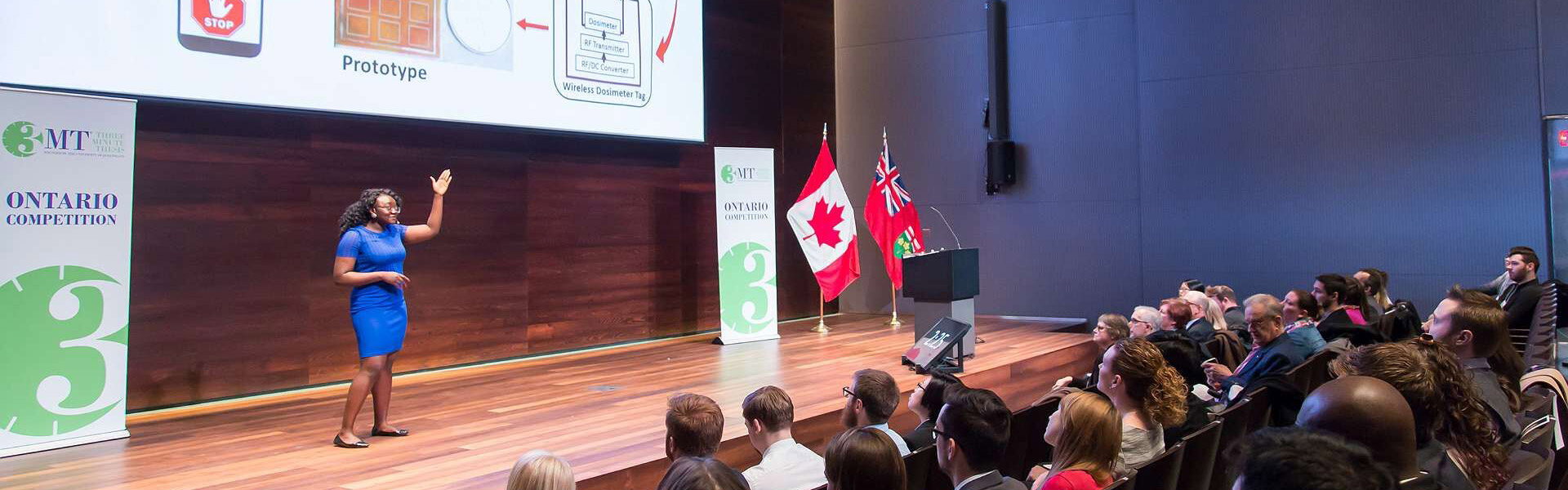
The Three Minute Thesis (3MT®) is a university-wide competition that challenges graduate students to present their research and its broader impact to a panel of non-specialist judges—in just three minutes and with only one static slide. The aim is to communicate complex ideas in an engaging, accessible, and compelling way.
Why participate?
3MT® provides graduate students with a unique opportunity to showcase their research to a diverse audience, both within Ontario Tech University and in the wider community. This fun yet challenging event sharpens essential communication skills, helping students to distill their work’s core message for non-specialist listeners. For audience members, 3MT® is a rare chance to hear about the innovative and significant research being conducted at Ontario Tech and its potential impact on the world.
Competition format and prizes
Participants will compete in preliminary heats, with top performers advancing to the university finals. Winners from our 3MT® competition may have the opportunity to represent Ontario Tech at provincial, national, or even international 3MT® events. Prizes are awarded to finalists, and all participants benefit from presentation coaching and valuable feedback.
Who can attend?
The competition is open to family, friends, and community members, making 3MT® a powerful way to celebrate and engage with the important research conducted by Ontario Tech’s graduate students.
3MT® history
The 3MT® competition began at the University of Queensland, Australia, in 2008. Today, 3MT® is held at more than 600 institutions across 65 countries, with participants engaging a global audience.
Ontario Tech held its first 3MT® competition in 2013, and that same year, the inaugural provincial competition in Ontario took place. Canada’s first national 3MT® followed in 2014.
Be part of the experience
Whether you’re a competitor, a supporter, or simply curious about graduate research, 3MT® is an inspiring event that brings Ontario Tech’s research to life. We look forward to your participation!
Date |
Event |
| Thursday, January 8 | Registration opens |
| Friday, January 30 | Registration closes |
| February to March | Coaching sessions |
| Friday, February 6 | Supervisor form due |
| Monday, March 9 | PowerPoint slide due |
| Wednesday, March 18 | 3MT® Heats |
| Thursday, March 19 | 3MT® Finals |
| Wednesday, April 22 | Northeastern Association of Graduate Schools (NAGS) Competition (ONLINE) |
| Wednesday, May 6 | Provincial Competition (Brock University) |
| Thursday, November 5 | National Competition (Regina, Saskatchewan) |
Why participate?
- Learn how to concisely explain the significance of your research.
- Sharpen your presentation skills.
- Receive individual coaching.
- Compete to represent Ontario Tech at the provincial 3MT® finals.
- Win cash prizes of up to $1,000.
Coaching sessions
Build your skills and confidence through a variety of coaching sessions. From individual consultations to interactive workshops, each session is designed to help you make the most of your three minutes and put your research into the spotlight.
Participant resources
Tips and resources for your presentation
- Coaching videos by John Handler, PhD (McMaster University)
- Making the Most of Your Three Minutes, Simon Clews, Writing Centre, University of Melbourne, Australia
- 3MT Presentation Skills Workshop slides 2013 - Queen's University (Williams, 2013)
- Communicating your research in lay language, Cristian A. Linte, IEEE Engineering in Medicine and Biology Magazine, May/June 2009, pages 5-7.
- How do you present years' worth of material in 30 minutes?
- 3MT Not Just for Scientists
- Using open images (from the Library)
- How to win Three Minute Thesis (Dr. Inger Mewburn, Australian National University)
Internal competition
3MT® Heats
Wednesday, March 18 | 9:30 a.m. to TBD
Location: RBC Meeting Place (BIT 1055)
Program
Live Stream: Watch the 3MT Heats online
3MT® Finals
Thursday, March 19 | 1 to 2:30 p.m.
Location: RBC Meeting Place (BIT 1055)
Program
Live Stream: Watch the 3MT Finals online
Prizes
The following prizes will be awarded at Ontario Tech's internal competition. The winner of the event will advance to the provincial finals.
| Winner | $1,000 |
| Runner-up | $500 |
| People's Choice Selection | $250 |
2026 3MT® Provincial Competition
Brock University - Wednesday, May 6
We extend our sincere gratitude to our sponsors for their generous support of the Three Minute Thesis (3MT®) competition at Ontario Tech University. Their contributions help us provide a platform for graduate students to showcase their research, refine their communication skills, and engage with the broader academic and professional community. Thanks to their support, we are able to celebrate the innovative work of our students and foster a dynamic research culture at Ontario Tech.
2026 Sponsors

Eligibility
To participate in 3MT® at the institutional (Ontario Tech University) level, students must meet the eligibility criteria outlined below:
- At the time of the 3MT® competition, students must be registered in a master's or PhD program.
- International and domestic students are eligible provided they are registered and are in clear standing.
- Clear Standing: Students are required to maintain a minimum grade of B-minus (GPA: 2.7) in all graded components of the program as well as satisfactory research progress in programs with a thesis, project or major paper.
- Full-time or part-time Master’s or Ph.D. students registered and in clear standing in thesis-based programs at the institutional level are eligible to participate. Course-based students actively engaged in research or research-creation projects may be eligible to participate at the discretion of the organizers.
- Course-based or non-thesis students must have their research involvement verified by a supervisor, project lead, or equivalent.
- PhD and master's students who have defended or have submitted their project, paper or portfolio, but have not yet convocated, are eligible.
- 3MT® presentations must represent the students own research that was conducted in their graduate program.
- Presenters must agree to be video-recorded and to allow those recordings to be made public.
Regional and National Competitions
To advance beyond the institutional level, competitors should meet the following eligibility requirements:
- Participants should be registered in a thesis-based Master’s or PhD program at a CAGS member institution (eligible for TRI-Council funding) and in good standing.
- Course-based, professional, visiting, exchange, postdoctoral or undergraduate participants are not eligible to advance beyond the local level.
- Competitors who have defended their thesis but not yet convocated at the time of the local competition remain eligible to advance.
- International students are eligible but should ensure their ability to travel during the dates of the regional and national competitions. Of note, they should remain able to travel if advancing to the North American showcase (usually takes place in the United States).
- All regional and national participants must agree to be photographed and recorded, and consent to have their presentation made publicly accessible.
Confidentiality and intellectual property (IP) considerations
Students must understand that the presentation of their research in 3MT® will be publicly accessible, i.e., in the public domain.
The presentation of the research will not affect any pre-existing rights following the competition, except as stated below:
- Due to the nature of the competition, we will not ask judges, reviewers, staff or the audience to sign non-disclosure statements. If your research is being/has been conducted under contract with an outside sponsor, you are required to discuss the related contractual terms of confidentiality and IP with your supervisor and the School of Graduate and Postdoctoral Studies (SGPS) before participating in this competition.
- All public sessions of the competition including, but not limited to, oral presentations are open to the public at large. Any and all of these public sessions may be broadcast to interested persons through media, which may include the Internet.
- Any data or information discussed or presented in public sessions should be considered public. If your research includes confidential, contractual, newly created IP or culturally sensitive material, you are required to discuss your competition entry with your supervisor(s) before entering the 3MT® competition. Please submit the 3MT® supervisor consent form signed by your supervisor(s) to the SGPS as evidence of this discussion.
In coordinating 3MT®, the university and any host institutions for the province-wide competition may take photographs, videotapes and/or audiotapes; make transcripts of the presentations; and/or copy material prepared for use in presentation at the 3MT® and any related events for promotional purposes and to support knowledge mobilization.
Testimonials will be requested of all participants after the events.
Rules/Regulations
- Presentations are considered to have commenced when a presenter starts their presentation through movement or speech.
- Presentations are to commence from the stage.
- Presentations are limited to three minutes maximum.
- Competitors exceeding three minutes are disqualified.
- Presentations must be administered in English.
- Presentations are to be spoken (i.e., no poems, raps or songs).
- Minor creative or cultural elements (e.g., gesture, posture, attire) may be integrated when intrinsic to the research, provided they do not distract from clarity or accessibility.
- No props (e.g., costumes, musical instruments, laboratory equipment) are permitted.
- Any cultural attire worn for reasons of identity or tradition is permitted.
- Presentations should be based on the participant’s own research or research-creation work and should be understandable to a general audience.
- Presenters must use language appropriate for a non-specialist audience, avoiding disciplinary jargon or unexplained acronyms.
- Physical interactions with the audience are not permitted.
- Presentations must be made by memory; notes may not be used.
Presentation slide
- A single, static slide is permitted for each presenter.
- The slide must not include transitions, animations, embedded videos, or audio.
- The slide design and content are left to the discretion of the competitor, provided all images and content used conform to Canadian copyright law.
- The slides should be created using the same aspect ratio, typically 16:9.
- No additional electronic media is permitted during the presentation, including but not limited to sound and audio files emitted from the stage or audience.
- A timing clock or timer is made visible for graduate students during their presentation.
Ethical and cultural considerations
- If a graduate student’s research includes confidential or culturally sensitive material, Ontario Tech advises that competition participants discuss the entry with their supervisor.
- Work involving Indigenous knowledge, community-based research, or culturally sensitive materials are encouraged to consult with their supervisor or community partners prior to participation.
- Presenters must ensure that the information shared is suitable for public dissemination and does not breach confidentiality, contractual, or cultural protocols.
Judging criteria
Communication (score out of 100)
- Did the graduate student use non-verbal communication (i.e. voice modulation, body language) effectively?
- Did the graduate student use language that was jargon-free, or if jargon was used, was it accompanied with an explanation to make terms understandable to a non-expert audience?
- Did the presentation follow a logical sequence?
- Did the graduate student use their three minutes effectively? Did they elaborate too long on a particular aspect? Did the presentation feel rushed or incomplete?
Comprehension (score out of 100)
- Did the presentation help you to understand the methodology behind the scholarly research being undertaken?
- Did the graduate student clearly outline the nature and purpose of their research?
- Did the graduate student clearly indicate the fascinating or compelling aspects of their research?
- Did the graduate student provide an understanding of the background and significance to the research question being addressed?
- Did the graduate student clearly describe the impact and/or results of the research, including any conclusions and outcomes, or further steps to be taken?
Engagement (score out of 100)
- Was the presentation engaging? Did the graduate student use creative language and storytelling to capture and maintain the audience's attention?
- Did the graduate student convey enthusiasm for their work?
- Was the graduate student careful not to trivialize or generalize their research?
- Did the PowerPoint slide create intrigue without dividing your attention – was it clear, legible, and concise?
- Did the presentation inspire you to want to know more?